
POLST vs. Advance Directives: Why the Bright Green Form Matters to WA Families
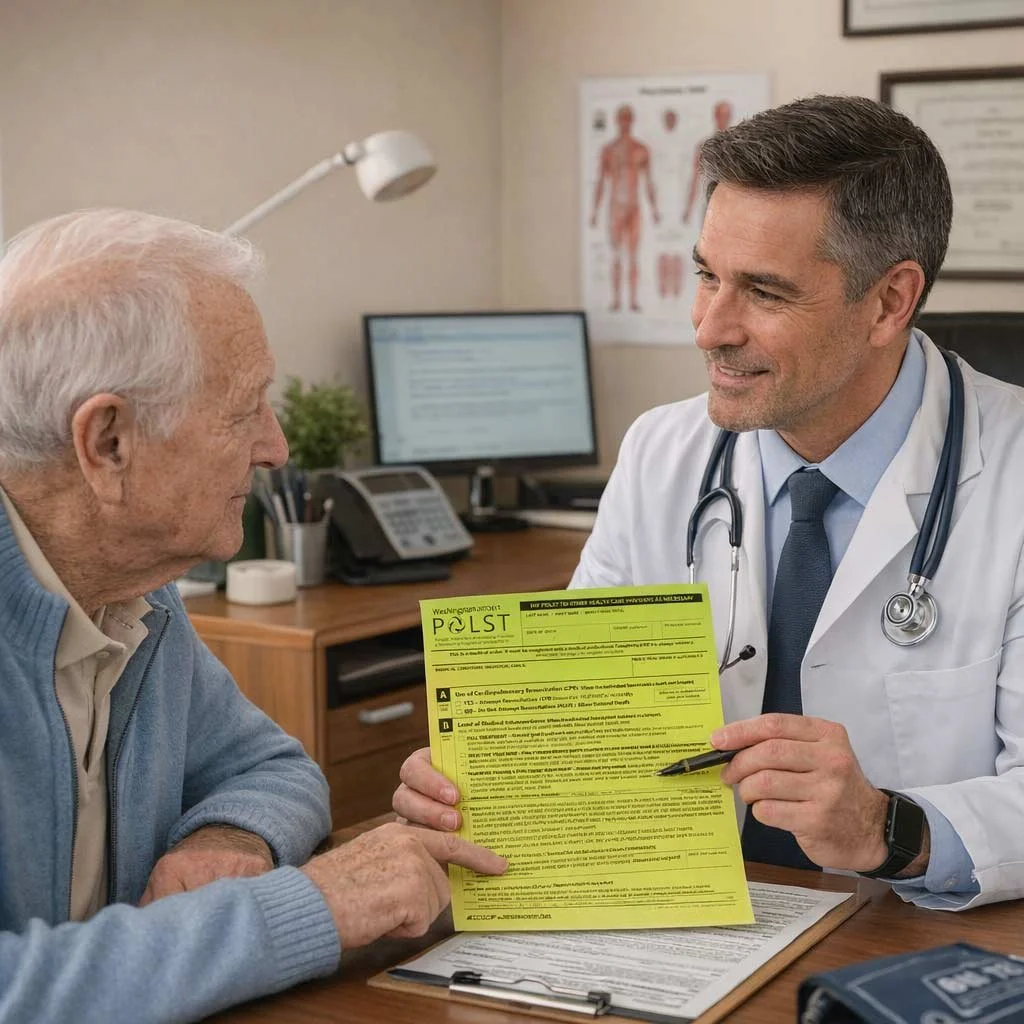
Image created with AI assistance
When I sit down with families during a nursing assessment, one question on the assessment form stumps many people. The question is, does your loved one have a POLST form in place? Most of the time, the response I hear is: "No, but we have advance directives — and Mom definitely doesn't want CPR."
That's an important start. But it's not enough. Here's what I want every family to understand about the POLST form — and why it could make all the difference in an emergency.
What is a POLST form, and how is it different from advance directives?
A POLST (Portable Order for Life-Sustaining Treatment) is a bright fluorescent green form, printed on both sides, that gives first responders and medical personnel immediate, clear instructions about your loved one's wishes — without having to search through pages of legal documents.
Advance directives are absolutely important to have. But in an emergency, they simply aren't practical. They're legal documents that take time to locate and time to read. When medics arrive at your door, there is no time for that. They need to know — right now — whether CPR is the right course of action. That's exactly what the POLST is designed to do.
When I'm completing an assessment and I ask a family if their loved one has a POLST, I often hear, "No, but we have advance directives and Mom wants no CPR." I gently explain that those advance directives, as important as they are, will not help medics in those first critical moments. The POLST form is what speaks for your loved one when they cannot speak for themselves.
Why saying "Mom doesn't want CPR" isn't enough without a POLST
One of the most important — and often most difficult — parts of my work is helping families understand what CPR actually looks like for a frail older adult. This isn't what we see on television.
CPR is physically forceful. It can and does break the sternum and rib bones, particularly in older adults with osteoporosis or those who are very frail. Fractured ribs can then puncture the lungs, causing a collapsed lung — which is itself a life-threatening complication. The road back from CPR can be long and painful.
When I'm having this conversation with families, I encourage them to really consider their loved one's physical condition. Is this a person who is well-muscled and fairly strong, with a good quality of life? Someone whose heart condition is the primary concern? In that case, CPR may be worth attempting. But if your loved one is frail, has osteoporosis, lives with dementia, is bed-bound or wheelchair-bound — their body may simply not be able to withstand the force of CPR. And attempting it can lead to prolonged suffering rather than a peaceful passing.
I've seen this play out in heartbreaking ways. A very frail woman with advanced Alzheimer's — someone who weighed 70 pounds, needed pureed food, had contractures that curled her body, and had a non-healing wound — had a POLST in place with a No CPR order. In the chaos of the moment, the order wasn't followed. CPR was performed. She survived. Her family had been prepared to say goodbye. Instead, she lived another two and a half years — completely bedbound, with ongoing non-healing wounds — at a care cost of around $12,000 a month. Her family, in their grief and grace, chose not to take legal action. But the situation was an avoidable tragedy.
That story stays with me. It's why I believe so strongly in helping families get this form in place.
Who should have a POLST form — even if they still live at home?
Here's something many people don't realize: people living independently at home may need a POLST most of all.
When someone lives alone and has a medical emergency, they are incredibly vulnerable. By the time they call 911 and medics arrive, they may no longer be conscious — they cannot express their wishes in that moment. Medics will do what they are trained to do: attempt to resuscitate. Without a POLST in hand, their default is to perform life-saving measures.
The same is true at the hospital. If a POLST form is not immediately available when a person is admitted and the heart stops, the hospital will begin CPR automatically. Their default is always to intervene unless there are specific orders — like a POLST — in place.
This applies across settings: Adult Family Homes, assisted living communities, rehabilitation centers, and private homes. Medics will make every effort to resuscitate without that form right in front of them.
If your loved one has strong feelings about end-of-life care, being proactive about the POLST is one of the most important things you can do — before a crisis, not during one.
Not sure if your loved one's current care situation puts them at risk?
→Let's talk through it together.
How do you get a POLST form in Washington State?
The POLST is a Washington State-specific document, and the process for completing it is straightforward — though it does require a doctor's involvement.
Here's what families need to know:
The form must be completed with a physician present. Your doctor will walk through the options with you and explain each choice. This is not something you can fill out on your own at home.
The person the form is for must sign it. If they are incapacitated and have assigned a Power of Attorney for healthcare decisions, their POA may sign on their behalf.
The doctor must also sign the form.
Decisions can always be changed. If circumstances shift or your loved one changes their mind, a new POLST can be completed. Nothing is permanent.
My best advice for making this happen: make the POLST a priority at your next appointment — or schedule an appointment specifically for this purpose. Doctors today are very busy. If you walk in without this as the stated goal, it may not get addressed. Be direct. Tell your doctor's office when you schedule: "I'd like to complete a POLST form at this visit."
If you're also starting to think about what level of care makes sense going forward:
→ I'd be glad to help you think it through
Where should you keep the POLST form so medics can actually find it?
A POLST only works if someone can find it quickly. Here's the challenge I hear from families all the time: the most obvious place to keep it — the refrigerator — is also the one people resist. Looking at that bright green form every day can feel like a constant reminder of something painful. I completely understand that.
Here's what medics have recommended over the years:
On the refrigerator — still the most universally known location; many medics will go straight there.
On the inside of the front door — visible the moment first responders enter the home.
In the freezer — rolled up inside a clearly marked plastic container. This one surprises people, but it's a well-known tip among emergency responders and is quite practical if the refrigerator feels too visible day-to-day.
Wherever you keep it, make sure your family members, any regular caregivers, and anyone who might call 911 on your loved one's behalf knows exactly where it is.
What should you do if your loved one has a No CPR order and you call 911?
This is something I feel strongly about sharing, because it's a situation many families aren't prepared for.
If your loved one has a POLST with a No CPR order and you find them without a pulse and not breathing, you still need to call 911. But here's the critical part: tell the 911 operator immediately and clearly that your loved one has a POLST with a No CPR order.
Be prepared: 911 operators are often trained to encourage callers to begin CPR while waiting for medics. They may push back. They may be persistent. In that moment, it is your job to be firm. Your loved one made this decision thoughtfully and deliberately. Do not go against their wishes.
Stay calm, state clearly that a POLST is in place, and hold the line on their behalf.
What are the quiet signs a family isn't prepared — and what to do about it?
After years of doing assessments, I can usually sense pretty quickly when a family hasn't had these conversations yet. There's often a vague mention that "Mom has some paperwork somewhere," or an assumption that the hospital will figure it out, or — very commonly — a hesitation that feels heavy and unspoken.
Here's what I want to say to the adult son or daughter who keeps delaying: I understand. This conversation feels like it's about death, and nobody wants to go there. But what the POLST is actually about is honoring your loved one's life — their values, their wishes, the kind of care they want if things take a turn.
If your loved one knows they don't want CPR — if they have expressed clearly that they do not want broken ribs, brain damage, lung damage, or a prolonged and painful recovery — then not having a POLST means there's a real risk that exactly that could happen.
You have the power to prevent that. It starts with one phone call to make an appointment.
Take the next step
If your loved one doesn't have a POLST form in place, I'd encourage you to reach out to their primary care provider this week — not next month, this week. Ask to schedule a visit specifically to complete the form. If you're in the process of exploring care options for an aging loved one in East King County and aren't sure where to start, I'm here to help.
A little preparation now can make an enormous difference when it matters most.
